
Description
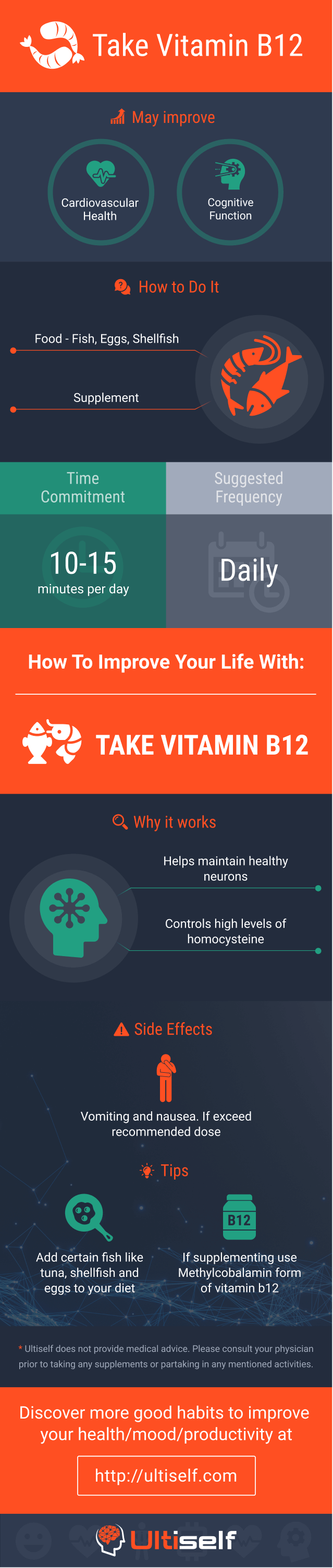
Vitamin B12 is known for its central role in the production of red blood cells and also in supporting the central nervous system. This vitamin can be found in a wide variety of foods, which is an advantage for obtaining it from our diet.

Benefits
- Helps protect against heart disease
- Improves cognitive function
- Prevents megaloblastic anemia

Required Equipment
Foods listed below or supplements with vitamin B12

How to Do It
Try to add the following foods that contain vitamin B12 to your diet: eggs, fish, certain shellfish, tuna. Some cereals also contain this vitamin.
Or you can supplement with a high quality product.
Why it works
- Vitamin B12 is central to the process of maintaining neurons, which are the basic units of central nervous system function. By helping to keep them healthy, their function is enhanced and we gain benefits in our daily activities.
- As for heart disease, its role is specifically to help control high levels of homocysteine, a chemical that increases the risk of cardiovascular disease.

Time Commitment
10-15 minutes

Suggested Frequency
Daily
Time of Day
Best 20 minutes before breakfast

Possible Side Effects
When high doses of vitamin B12 are consumed, symptoms such as: vomiting, nausea, headache, dizziness, among others, may appear.

Tips
- The average adult needs approximately 2.4 micrograms of vitamin B12 per day. For most this can be achieved without supplementation.
- In some specific cases, people may be deficient in this vitamin, so they must make up for it by taking supplements or other products that contain it.
- There are a few types of vitamin b12 supplements. Methylcobalamin Is typically the most natural and best option.
Supporting Studies
Expand Collapse- Vitamin B12 and B12‐Proteins. https://onlinelibrary.wiley.com/doi/book/10.1002/9783527612192
- Vitamin B12 deficiency can be sneaky, harmful. https://www.health.harvard.edu/blog/vitamin-b12-deficiency-can-be-sneaky-harmful-201301105780
- An Ontario-wide study of vitamin B12, serum folate, and red cell folate levels in relation to plasma homocysteine: is a preventable public health issue on the rise?. https://www.ncbi.nlm.nih.gov/pubmed/11018684
- Vitamin B12 in Health and Disease. https://www.ncbi.nlm.nih.gov/pmc/articles/PMC3257642/
- Vitamin B12 Intake From Animal Foods, Biomarkers, and Health Aspects. https://www.ncbi.nlm.nih.gov/pmc/articles/PMC6611390/
- B Vitamins and the Brain: Mechanisms, Dose and Efficacy—A Review. https://www.ncbi.nlm.nih.gov/pmc/articles/PMC4772032/