
Description
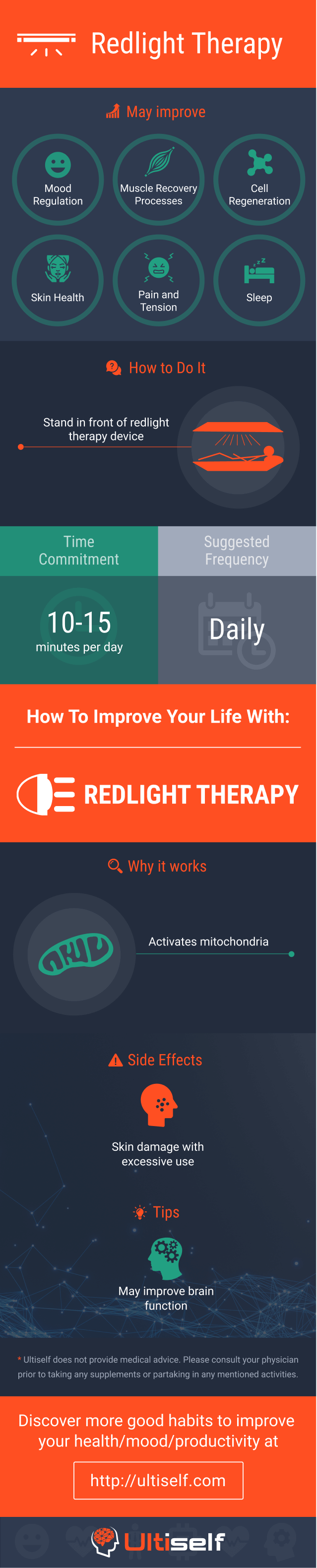
Redlight therapy has been shown to be useful in the treatment of skin disorders, such as wounds, scars or other damage. It has also been shown to be useful for other health-related purposes.

Possible Benefits
- Improve your skin health
- Helps reduce pain and tension
- Mood regulation aid
- Stimulates cell regeneration
- Helps reduce muscle fatigue
- Stimulates muscle recovery processes
- Improves sleep by helping to regulate biological rhythms
- Decreases inflammation
- Gives your skin a younger look

Required Equipment
Red light therapy lamp

How to Do It
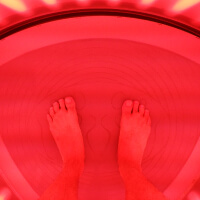
Redlight therapy is very simple, just sit or stand, with the light source about 10-15 centimeters away from the area of your body that you want to stimulate.
Why it works
The central process that makes redlight therapy have health benefits is the activity on the mitochondria of our body cells. As you may know, the mitochondria is a part of the cell that functions as a "powerhouse”. So, what redlight therapy does, is to accelerate and optimize the functioning of the cells, and thus restore some damage caused in our body.

Time Commitment
10-15 minutes

Suggested Frequency
Daily
Suggested Time of Day
Anytime

Side Effects
Exceeding the recommended time and distance can cause skin damage, so it is important to follow the recommendations.
It is recommended that you get professional help for further advice on the use of this technique.

Notes
- Redlight therapy is a controversial therapeutic approach, as it is said to offer many benefits in different functions and organs of the body. There is partial evidence for the functioning of this. As for the treatment of skin damage, there is more empirical support.
- One of the areas of current exploration is in the improvement of brain function, where several promising studies have been conducted [7], [8].
Related Products
Sun lamp
Supporting Studies and Articles
Expand Collapse- A Controlled Trial to Determine the Efficacy of Red and Near-Infrared Light Treatment in Patient Satisfaction, Reduction of Fine Lines, Wrinkles, Skin Roughness, and Intradermal Collagen Density Increase. https://www.ncbi.nlm.nih.gov/pmc/articles/PMC3926176/
- Low-level laser (light) therapy (LLLT) in skin: stimulating, healing, restoring. https://www.ncbi.nlm.nih.gov/pmc/articles/PMC4126803/
- Influence of low-level laser irradiation on osteocalcin protein and gene expression in bone tissue1. https://www.ncbi.nlm.nih.gov/pubmed/30328905
- A case control series for the effect of photobiomodulation in patients with low back pain and concurrent depression. https://www.jstage.jst.go.jp/article/islsm/27/3/27_27_18-OR-18/_article
- Lack of exposure to natural light in the workspace is associated with physiological, sleep and depressive symptoms. https://www.ncbi.nlm.nih.gov/pubmed/25424517
- Biphasic Dose Response in Low Level Light Therapy. https://www.ncbi.nlm.nih.gov/pmc/articles/PMC2790317/
- Transcranial infrared laser stimulation produces beneficial cognitive and emotional effects in humans. https://www.ncbi.nlm.nih.gov/pubmed/23200785
- Improving executive function using transcranial infrared laser stimulation. https://www.ncbi.nlm.nih.gov/pubmed/26017772