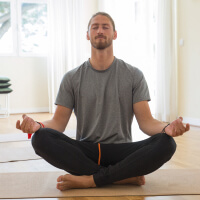

Description
Meditation is an ancient practice that’s making a comeback. Meditation involves consciously focusing your mind on the present moment in an effort to become a more peaceful, clear and focused.

How to Do It
Meditation can be practiced anywhere at any time. There are various techniques and variations of meditation. The most common and simple type of meditation is called mindfulness meditation. The goal of mindfulness meditation is to be mindful of your surroundings.
Here’s how to practice mindfulness meditation:
- Sit down and close your eyes
- Focus on slowly breathing in through your nose
- Listen to the sound of your breath
- Focus on breathing in through your belly rather than your chest
- As thoughts come into your mind, try to avoid judging them
- Continue to focus on the sound of your breathing each time you feel distracted

Benefits
- Decreases stress, anxiety and fear
- Helps with addictive behavior
- May decreases the risk of age-related cognitive disease
- Increases empathy

Time Commitment
10-20 minutes per day

Why it works
Research has shown that meditation decreases cortisol, also known as the stress hormone. One study looking at 1300 adults showed that those with the highest stress levels experienced the largest reduction in stress from meditation [1]. According to research, meditation decreases the size of an area of the brain called the amygdala, which is responsible for stress, anxiety, and fear [2].
Meditation may be able to help fight addictions. Research has shown that because meditation increases willpower and helps one control their emotional impulses, it may, therefore, be an effective way to help people understand their addictive traits [3], [4].
New research has shown that meditation may help to prevent the early onset of age-related cognitive diseases such as Alzheimer's disease. One review of the current evidence concluded that 12 minutes of meditation per day may improve memory in people with cognitive decline and impairment [5]. The exact reason why it works isn’t fully understood yet.
Studies looking at compassion meditation showed that it can help to improve "empathic accuracy" by causing changes to areas of the brain associated with empathy and human connection [6].

Suggested Frequency
Once or more per day

Supporting Studies and Articles
- https://www.ncbi.nlm.nih.gov/pubmed/24107199
- https://www.ncbi.nlm.nih.gov/pmc/articles/PMC4666115/
- https://www.ncbi.nlm.nih.gov/pubmed/27012254
- https://www.ncbi.nlm.nih.gov/pubmed/26784917
- https://www.ncbi.nlm.nih.gov/pubmed/26445019
- https://www.ncbi.nlm.nih.gov/pmc/articles/PMC3541495/
- https://www.ncbi.nlm.nih.gov/pubmed/1428622
- https://www.ncbi.nlm.nih.gov/pmc/articles/PMC5584749/

Side Effects
Meditation has a lot of benefits, however, it can also have adverse effects for some people.
- A study on long-term meditators found that 17 of the 27 subjects reported at least one negative side effect [7].
- A survey concluded that some adverse effects included stress, disorientation, and dependence on meditation as a form of escapism [8].
Although severe side effects from meditating are relatively uncommon, they may still occur, especially in those with underlying psychological issues.
Required Equipment
N/A
Gurus/Celebrities/Doing it
Dalai Lama
Jeff Weiner
Oprah Winfrey
Russel Simmons

Rating
Key Habit
Suggested Time of Day
You can meditate anytime you want. Most people anecdotally report that meditating early in the morning or late at night works best.
Notes
- Start slow. It’s better to meditate for five minutes per day consistently for one month rather than meditate for 30 minutes per day and stop after one week.
- You can practice meditation while doing daily activities such as cleaning or drinking coffee. Simply focus on the activity you’re doing and try to remain mindful while doing it.
Related Products
A great idea is to try the Inner Balance App, which works with a device to measure your heart rate. The constant feedback of your heart rate variability guides each meditation session. It helps you reduce stress, fatigue, and achieve a state of calm and balance. Click here to get your Inner Balance sensor!