
Description
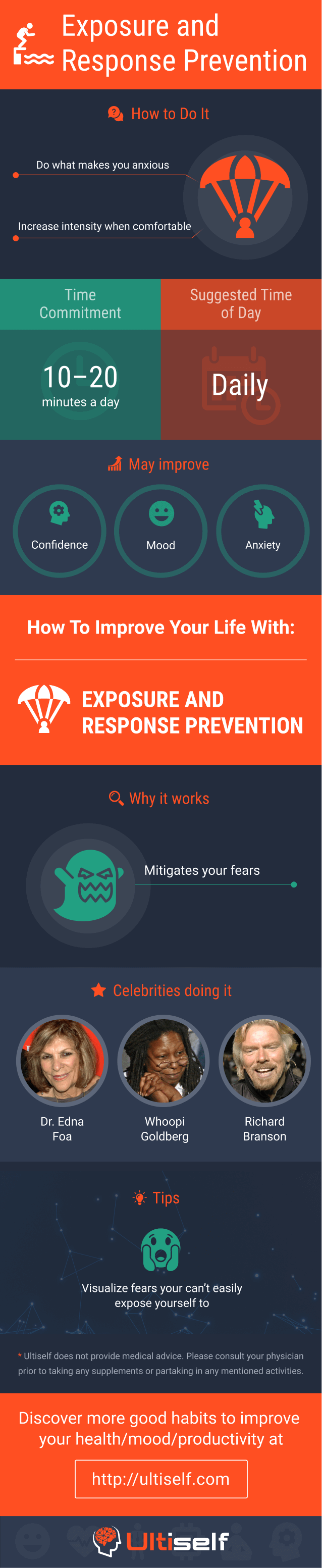
Exposure and Response Prevention (ERP) is a cognitive behavioral exercise that decrease anxiety and improve confidence. The premise behind this exercise to gradually expose yourself to uncomfortable and anxiety/fear inducing situations in order to diminish your anxiety and fears and thus increase your overall confidence and state of well being.

How to Do It
A therapist may offer you ERP. In this case, carefully follow the instructions of your therapist.
If you are not in therapy, a daily habit version of ERP can be adopted.
Commit to a path of non-avoidance by actively engaging with things that make you anxious or uncomfortable situations on a regular basis.
For example, if you have a phobia of spiders, you could look at a photo of a spider every day. Once you are comfortable with that, watch a video. By increasing the intensity of exposure whenever you are comfortable, you should eventually stop responding to the uncomfortable situation with avoidance, and be able to function much better overcome your fears and gain confidence.
Identify what makes you anxious and how you could expose yourself to that situation on a regular basis. This can be social situations and activities which you dread like public speaking and phobias.
Disclaimer: Please do not put yourself in situations that can endanger your life or health. Please consult a doctor for any activities that may affect your physical or mental health.

Benefits
- Reduces anxiety and fear[1:5]
- Improves mood[1:5]
- Increases confidence and productivity[6]

Time Commitment
10-20 minutes a day.

Why it works
- Avoiding things that make you anxious can bring relief. This positive feeling becomes associated with avoidance behaviors,which reinforces them. Much in the same way as dogs are trained (by rewarding behaviors), by avoiding things, you’re training yourself to continue avoiding things. This can lead to the development of anxiety disorders and lower confidence or simply result in lost opportunities. Intentionally exposing yourself to anxiety-inducing situations helps break this response pattern (avoidance), ultimately improving your relationship with anxiety, allowing you to function well in situations you used to find incapacitating.
- Exposing yourself to anxiousness builds a more realistic perception of what it means to be anxious. You learn to accept anxiety as something that doesn’t need to be avoided.

Suggested Frequency
Daily

Supporting Studies and Articles
- https://www.sciencedirect.com/science/article/abs/pii/S000579670000022X
- https://www.ncbi.nlm.nih.gov/pubmed/30054173
- https://psycnet.apa.org/record/2016-27132-009
- https://www.ncbi.nlm.nih.gov/pmc/articles/PMC6343408/
- https://www.annualreviews.org/doi/pdf/10.1146/annurev-clinpsy-021815-093533
- https://www.journals.uchicago.edu/doi/abs/10.1086/681096
Gurus/Celebrities/Doing it
Dr. Edna Foa
Whoopi Goldberg
Richard Branson

Category Health/Productivity/Mood:
Mood
Notes
Some anxieties, like fear of flying or public speaking, are hard to expose yourself to in everyday situations. Visualisation can be useful in these cases. And, if you have the equipment, virtual reality environments can be utilised as a controlled setting to face fears and anxieties.