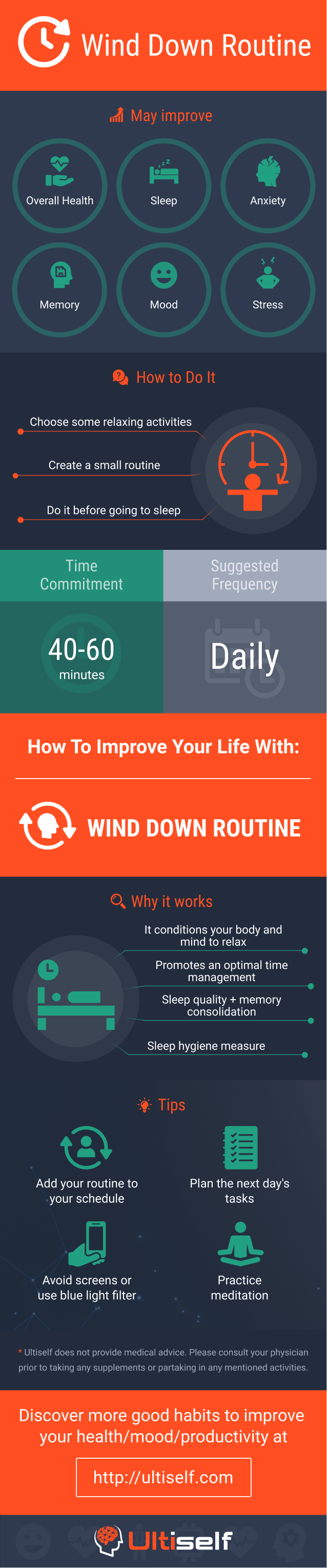

Description
The wind-down routine is a time of transition between daytime activities and bedtime. It includes quiet and relaxing activities, which involve little physical and mental activation.

Possible Benefits
- May improve your sleep
- May decrease stress level
- May reduce anxiety
- May improve memory
- May improve your well-being
- May support your overall health
- May boost your mood

How to Do It
Choose some quiet and relaxing activities to do at night before going to sleep. They should be activities that you like and enjoy. Think about what you want to do at the end of a busy day.
Some suggestions are:
- Reading
- Listening to your favorite playlist
- Taking a shower and relaxing in bed
- Exercising 2-3 hours before sleeping
- Journaling
You should also avoid caffeine and sugary drinks at least 3 hours before sleeping. Make sure your room has a cool temperature and is dark enough for sleep.

Why it works
- Having a time at night for your wind-down routine may condition your body and mind to go into a state of relaxation.
- It is easier to fall asleep when the body and mind are relaxed.
- By planning your nightly routine you can improve your time management and thus your productivity.
- Sleep hygiene measures involve creating an adequate and exclusively dedicated space for sleeping.
- The quality of sleep improves the consolidation of memory and what you have learned during the day.

Time Commitment
40-60 minutes

Suggested Frequency
Daily
Time of Day
At night before going to bed

Possible Side Effects
None known

Tips
- Use lavender oil to set the mood in your room
- Plan the next day's tasks, so you can reduce your anxiety
- Avoid screen or use blue light filter to improve melatonin production
- Write down your routine and add it to your daily schedule
- Practice meditation
Supporting Studies and Articles
Expand Collapse- Relations among mindfulness, well-being, and sleep. https://www.academia.edu/14465102/Relations_among_mindfulness_well_being_and_sleep
- Lavender and sleep: a systematic review of the evidence. https://researchportal.port.ac.uk/portal/en/publications/lavender-and-sleep(8609d272-a9cd-4c91-b6f9-81ec364b6b23)/export.html
- Walk to a better night of sleep: testing the relationship between physical activity and sleep. https://pubmed.ncbi.nlm.nih.gov/31358470/
- Feeling exhausted or vigorous in anticipation of high workload? The role of worry and planning during the evening. https://bpspsychub.onlinelibrary.wiley.com/doi/full/10.1111/joop.12290
- Behavioral Strategies, Including Exercise, for Addressing Insomnia. https://www.ncbi.nlm.nih.gov/pmc/articles/PMC6715137/
- Psychological and behavioral treatment of insomnia:update of the recent evidence (1998-2004). https://pubmed.ncbi.nlm.nih.gov/17162986/
- Youth screen media habits and sleep: sleep-friendly screen-behavior recommendations for clinicians, educators, and parents. https://www.ncbi.nlm.nih.gov/pmc/articles/PMC5839336/