
Definition
Positive self-talk is like having an optimistic person inside your head telling you there’s a bright side to everything. It also helps reaffirm your abilities.

How to Do It
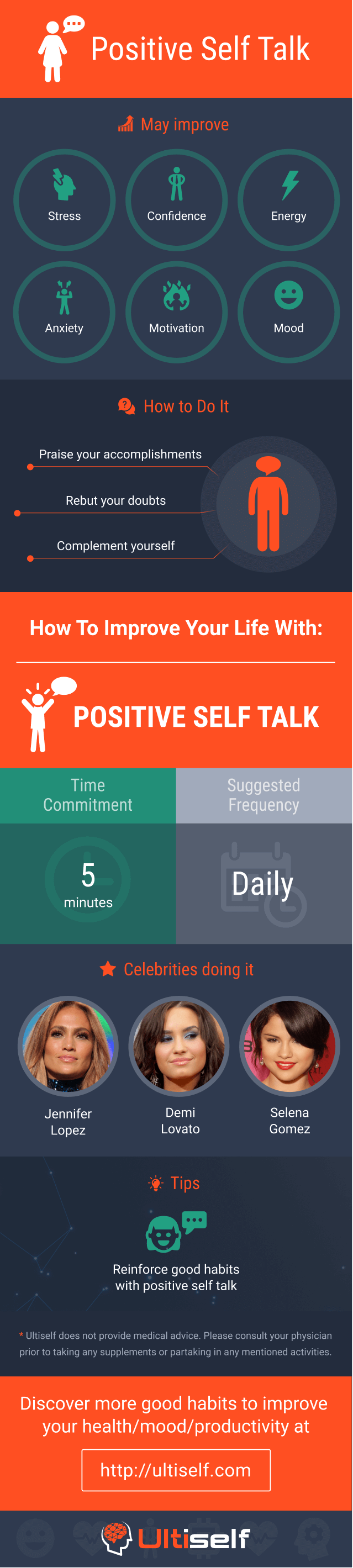
As you go about each day, let yourself know that you are doing a good job. Say good things about what you’ve accomplished or positive thoughts about what you are working on.
Think about what you would tell a friend going through a similar task and tell it to yourself. Let yourself know that you can handle what you are worried about.
Make a list of the positive things about yourself and turn “can’t” into “what can I do” in tough situations.

Benefits
- Will power
- Pain Tolerance
- Happyness
- Stress Management
- Immune Function
- Energy

Time Commitment
5 minutes

Why it works
Positive self talk forces your brain to think positively. Positive outlook is linked to a decrease in stress and stress-related health issues.
Positive self-talk also helps achieve tasks, resulting in improved mood and well-being. It helps you maintain healthy habits and routines.

Suggested Frequency
Daily

Side Effects
- You may end up Ignoring the obstacles.
- Egocentrism instead of busting the ability to solve tasks.
- Positive self-talk can cause stress as a consequence of long-term usage.
- It can be overemphasized, so individuals put too much effort into being positive.
Required Equipment
None.
Gurus/Celebrities/Doing it
Jennifer Lopez
Demi Lovato
Selena Gomez
Suggested Time of Day
Any

Notes
- Positive self-talk makes you feel good about yourself
- Positive self-talk can reinforce behaviors and habits you are trying to pick up
- Perform positive self-talk proactively for behaviors you want to encourage yourself to do
Supporting Studies and Articles
Expand Collapse- Hardy, J., Gammage, K., & Hall, C. (2001). A descriptive study of athlete self-talk. The Sport Psychologist, 15(3), 306-318.
- Burnett, P. C. (1996). Children's self‐talk and significant others’ positive and negative statements. Educational Psychology, 16(1), 57-67.
- Burnett, P. C. (1999). Children's Self‐Talk and Academic Self‐Concepts: The impact of teachers’ statements. Educational Psychology in Practice, 15(3), 195-200.
- Hardy, J. (2006). Speaking clearly: A critical review of the self-talk literature. Psychology of Sport and Exercise, 7(1), 81-97.
- Van Raalte, J. L., Brewer, B. W., Rivera, P. M., & Petitpas, A. J. (1994). The relationship between observable self-talk and competitive junior tennis players' match performances. Journal of Sport and Exercise Psychology, 16(4), 400-415.