
Description
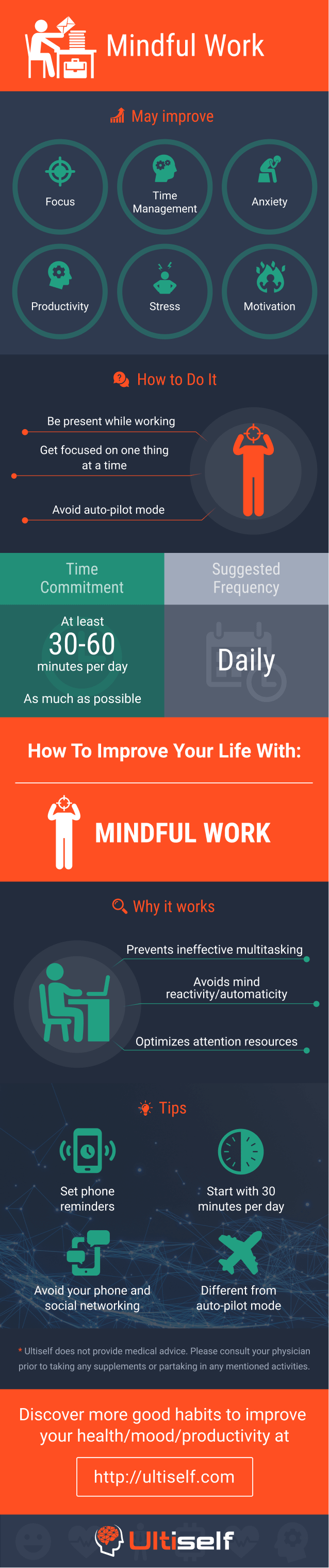
Mindful work is the practice of being fully present at the moment while working. It means focusing on one thing at a time and being aware of the task and your inner experience. Unlike working in “auto-pilot” mode, mindful work is consciously working as much as you can.

Possible Benefits
- May improve focus
- May boost your productivity
- May decrease procrastination
- May improve time management
- May decrease anxiety
- May decrease stress level
- May improve motivation

How to Do It
Practicing mindful work is simple. Focus on one thing at a time and try to be fully aware of it while you’re working.
Don’t worry, it’s common to get distracted or forget about the exercise. Be aware of it and gradually come back to mindful work. You will improve your ability with practice.

Why it works
- Multitasking sometimes becomes less effective, even when you feel that you are achieving more. Multitasking may lead to procrastination or bad time management habits. Mindful work promotes focusing on a single task so you put all your resources on it.
- When you focus on one thing at a time, you become oriented to achievement, and not just ineffective effort.
- Mindfulness practices have been proven to decrease anxiety and stress levels, as they train your mind to be less reactive and automatic.

Time Commitment
At least 30-60 minutes per day
As much as possible

Suggested Frequency
Daily
Time of Day
During working hours

Possible Side Effects
None known.

Tips
- Being mindful at work is not being disconnected from your workplace environment
- Set phone reminders to keep practicing this habit at work
- Start with 30 minutes per day and increase the time gradually
- Avoid distractions like personal phone use and social networking
Supporting Studies and Articles
Expand Collapse- Effects of Mindfulness-Based Stress Reduction on employees’ mental health: A systematic review. https://www.ncbi.nlm.nih.gov/pmc/articles/PMC5783379/
- How Is Stress Reduced by a Workplace Mindfulness Intervention? A Qualitative Study Conceptualising Experiences of Change. https://www.ncbi.nlm.nih.gov/pmc/articles/PMC5866844/
- Mindfulness and Symptoms of Depression and Anxiety in the General Population: The Mediating Roles of Worry, Rumination, Reappraisal and Suppression. https://www.ncbi.nlm.nih.gov/pmc/articles/PMC6418017/
- Mindfulness-Based Interventions for Anxiety and Depression. https://www.ncbi.nlm.nih.gov/pmc/articles/PMC5679245/
- Effects of Mindfulness-Based Stress Reduction (MBSR) on Emotion Regulation in Social Anxiety Disorder. https://www.ncbi.nlm.nih.gov/pmc/articles/PMC4203918/
- Effectiveness of mindfulness-based stress reduction in a community sample over 2 years. https://pubmed.ncbi.nlm.nih.gov/29373618/
- Effects of Mindfulness on Psychological Health: A Review of Empirical Studies. https://www.ncbi.nlm.nih.gov/pmc/articles/PMC3679190/
- Effects of mindfulness training on perceived stress, self-compassion, and self-reflection of primary care physicians: a mixed-methods study. https://www.ncbi.nlm.nih.gov/pmc/articles/PMC6348323/