
Description
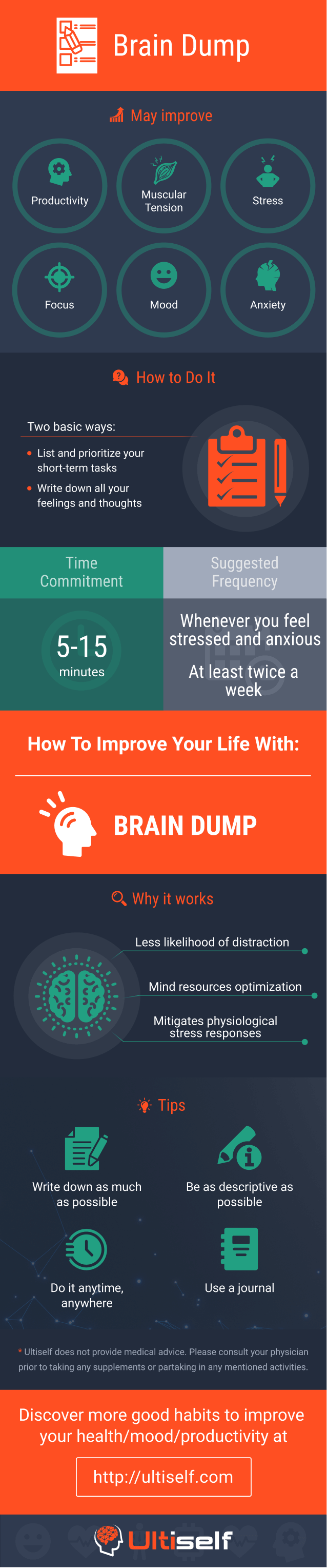
The brain dump is a way to release stress and excess information in your mind. It is a quick technique that uses writing and may help counteract the disadvantages of having a busy life with little free time.

Possible Benefits
- May decrease stress
- May improve focus
- May boost your productivity
- May improve mood
- May reduce anxiety
- May decrease muscular tension

Required Equipment
Paper and pencil. You can get a journal to do this regularly.

How to Do It
You can practice this habit in two basic ways:
- List and prioritize your short-term tasks. When you feel overwhelmed by your tasks, take paper and pencil and write down your most important and urgent tasks you have. Then prioritize them and create a quick schedule to start completing them.
- Release tension and information overload. When you feel stressed, take a pencil and paper and write down EVERYTHING you are thinking and feeling. It doesn't matter if it's just a few ideas. This will refresh your brain.
Why it works
- According to a study by the University of Minnesota, it takes about 23 minutes to restore focus after a distraction. By releasing the excess information in your mind, focus is much more effective.
- The mind has limited resources. When there is too much information, the level of stress and anxiety increases. This negatively affects productivity.
- When anxiety is sustained, it generates physiological changes such as muscle tension, increased heart rate and temperature changes. If you manage to prioritize your tasks and/or decrease the level of information in your mind, these changes in the body are diminished.

Time Commitment
5-15 minutes

Suggested Frequency
Whenever you feel stressed and anxious
At least twice a week
Time of Day
Any

Possible Side Effects
None known.

Tips
- Do this until you feel there is nothing more to write about.
- Do it anytime, anywhere.
- You can condition your mind to avoid information overload.
- Be as descriptive as possible when you write down what you feel and think.
- Use a journal to keep track and see if there is a pattern to what you are stressed about.
Supporting Studies and Articles
Expand Collapse- Why is it so hard to do my work? The challenge of attention residue when switching between work tasks. https://www.sciencedirect.com/science/article/abs/pii/S0749597809000399
- How To Declutter Your Mind: 10 Practical Tips You'll Actually Want To Try. https://www.forbes.com/sites/nomanazish/2017/11/19/how-to-declutter-your-mind-10-practical-tips-youll-actually-want-to-try/#620aaf6424f1
- Restoring Attention Networks. https://www.ncbi.nlm.nih.gov/pmc/articles/PMC6430178/
- How Concentration Shields Against Distraction. https://www.ncbi.nlm.nih.gov/pmc/articles/PMC4536538/
- Effects of distraction on memory and cognition: a commentary. https://www.ncbi.nlm.nih.gov/pmc/articles/PMC4114291/
- (Indoor) isolation, stress and physical inactivity: vicious circles accelerated by Covid‐19? https://www.ncbi.nlm.nih.gov/pmc/articles/PMC7267366/
- Relaxation Techniques. https://www.ncbi.nlm.nih.gov/books/NBK513238/
- Declutter Your Mind: How to Stop Worrying, Relieve Anxiety, and Eliminate Negative Thinking. https://www.amazon.com/-/es/S-J-Scott-ebook/dp/B01KU04K5A